

Your website traffic is under threat. AI is developing at an extraordinary pace and, while debates as to the quality of the output rumble on, the early effects of AI Large Language Models in search are already undeniable.
The effects for some have already been catastrophic, with some sites reporting a 73% drop in traffic from search when Google presents an AI overview. People commonly talk about the evolution of AI – we suggest it’s your own evolution which should preoccupy you.
You don‘t want to end up like this lad …

… and it’s not just Google. AI is changing user interaction everywhere – the zero-click search (where a user finds the answer to their query without leaving the search page) is an increasingly common phenomenon.
Increasingly, users aren’t even heading to a search page:
- With tools like Microsoft’s Copilot®, the answer is often provided inside the context of the IDE (web development software) … the user is only dully aware that they are searching at all.
- ChatGPT is already the primary search tool for a growing proportion of the Internet’s user base (740% growth in just 12 months).
Search results just aren’t what they used to be.
It’s not surprising – AI-generated search is convenient, fast, often requires less effort and feels more human.
The genie is out of the bottle. The comet has struck … the crisis is upon us. We already have clients, at #1 in Google for a number of key terms, suffering a significant fall-off in traffic.
Get with the mammals – the dinosaurs are already history. The time to act is now.
Table of Contents
Caveat
All this is changing … and fast. For example, this week, we observed Google AI overviews appearing below organic search results – restoring primacy to ‘natural‘ results for the first time. As of July 2025, AI overviews are still not enabled within the EU – the argument being that Google is breaching trust laws by repurposing original content with little credit to the author.
Some of this article will be out of date soon …
… But!
Nothing we recommend here will do your website harm. Broader strategies for capturing website traffic will always benefit your site.
Long-term answers lie in adapting your content strategy, rethinking SEO, branding and adding genuine value that AI can’t easily replicate. Adding value and having a good content strategy have never been bad ideas.
If you are less visible, make yourself more recognisable. When has gaining recognition ever been a mistake?
So here are five essential tips to help you maintain and even grow your website traffic in the thick of the AI maelstrom. They may not be quick to do, they may take a while to gain traction; but they will gain your website traffic.
1. Double Down on Creating Original, Authoritative Content … Lots of It
Search engines and AI models draw almost exclusively on existing web content to provide answers. As the volume of AI-generated content grows, the proportion of the Internet built out of “real” content will shrink. If that is the case, then the value of that first-hand, human-written content will only grow. As always, if your content is original, authoritative and not easily summarised in a single sentence, you gain a distinct advantage.
Indeed, removing the need to phrase your content in terms of narrowly defined “keywords” could well improve the quality of your content.
Of particular value will is:
- First-hand insights (e.g. original research, interviews, data analysis)
- Opinion pieces or expert commentary
- In-depth how-to guides that offer unique angles or proprietary methods
- Case studies and personal stories with a human element
All of this is great content already and the internet has always been hungry for great content. The drive for content that matches conversational queries – so called long-tail searches – has been present for some years. Great content will provide you many more opportunities to appear on the Search Engine results page.
AI also tends to summarise rather than explore. So content that dives deeper, tells stories or includes behind-the-scenes knowledge is more likely to drive engaged visits and backlinks – two things that AI can’t replace.
Attribution
If your content is any good, AI is still going to summarise your work. To gain website traffic, make the most of that. Ensure that your metadata (page title and description) is detailed, unique, engaging and accurate. The #1 attribution spot is a valuable source of website traffic. In some ways, it’s actually better than a traditional organic #1 spot – you‘re closer than ever to the top of the page, branded, and you get to show a photo.
You need a quality image associated with your posts and pages.
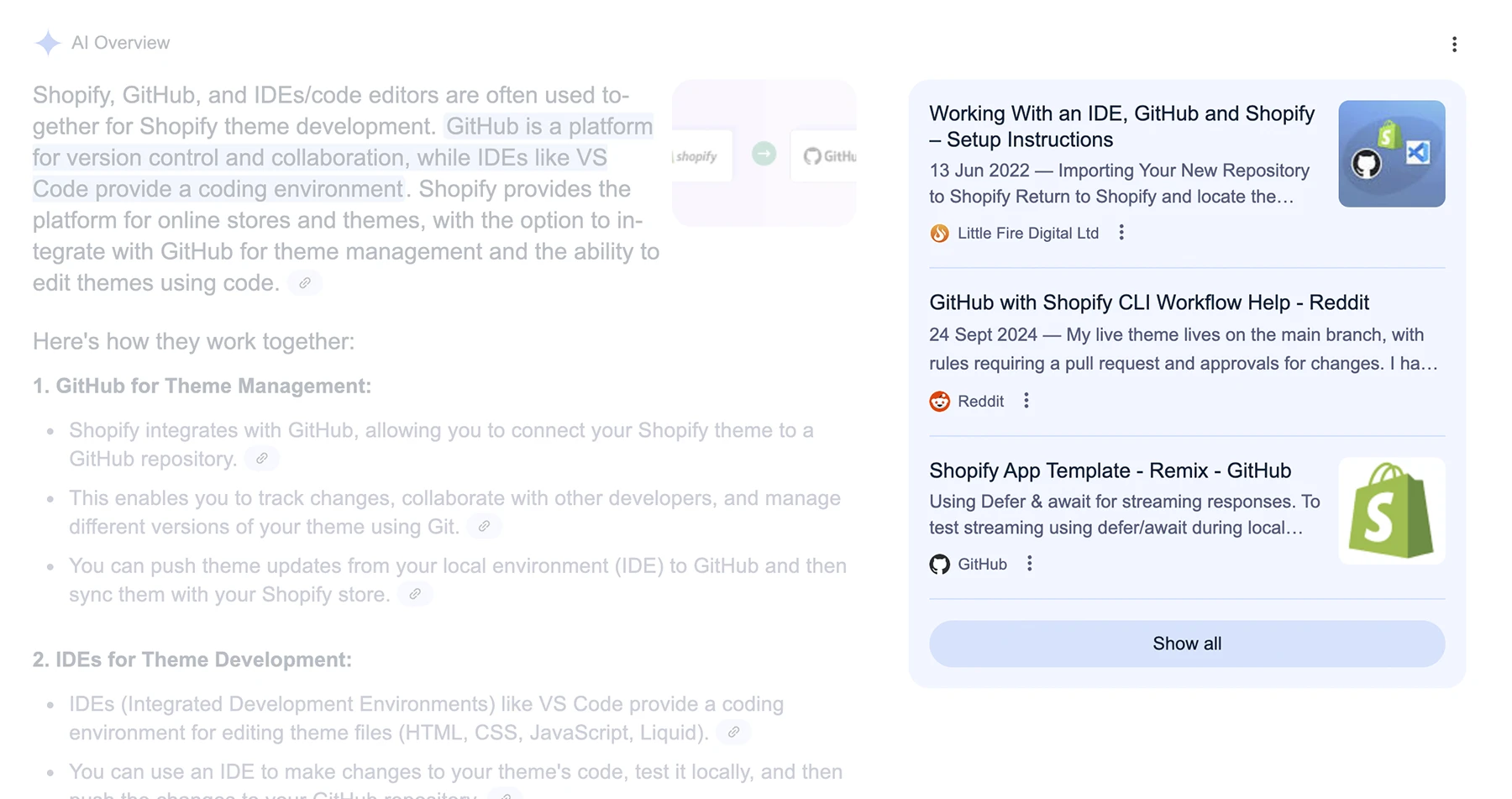
Attribution is going to be a key part of maintaining website traffic – keep your content relevant and authoritative.
Little Fire keep a busy, active and (we hope) informative blog. We are often cited in Google’s overviews, and our website traffic has grown considerably over the last 12 months.
Tip: An AI overview is a summary. Make your content easy to summarise. Use schema markup (like “Article”, “FAQ”, or “HowTo”) to help search engines better understand and display your content in richer formats.
2. Build a Strong Brand
The best brands have a persona – AI doesn’t. The trust generated by a brand drives a return (loyalty) in the customer. Familiarity with a brand is trust and, once earned, trust short circuits many decision making processes in the client.
Looking for a Starbucks on a busy high street offers that brand an edge over a generic, independent coffee shop. Likewise, AI search may supersede traditional search, but a direct search for a specific brand will supersede that.
Brand building is not instant – but as people jam amazon.co.uk or apple.com straight into the search bar – it can bypass search altogether: brand equity may well represent your best path to maintaining traffic.
It’s a huge task, creating a brand, but here are some things you can do to start building:
- Creating a consistent tone of voice across your content – your content needs to be recognisable, whatever its context. Colour schemes, logos, fonts, they all matter.
- Building an email list but ensure that you only share content of value.
- Engaging with your audience on social media or forums.
- If your company is small, it’s likely the company persona will resemble (or be) yours – get yourself out there with video content, podcasts and public appearances. There’s nothing like getting yourself in front of people for getting yourself in front of the right people.
Brand loyalty matters – if you’re a fan of Marmaduke’s in Sheffield, then you will cheerfully walk past any number of Starbucks to get there. It’s a field where talent and personality can beat huge budgets. Pick up a book on the subject and give it a go … or call people who can help.
3. Earning the Clicks
Ranking #1 on Google used to be the holy grail. But with AI overviews, rich snippets, and “zero-click” search results, visibility doesn’t always translate to clicks. Visibility may not be enough – you need to ensure you engage early.
To earn the click:
- Write compelling meta titles and descriptions that stand out and spark curiosity
- Consider using question-based headlines that signal deeper answers (e.g. “Why Most Freelancers Undercharge – and How You Can Fix It”)
- Add unique value propositions in the first paragraph (e.g. “Here’s what we learnt from 10,000+ customer reviews…”)
… but beware of offering click-bait. It is poor netiquette to engage users on a false premise – if your page claims to offer “revolutionary weight-loss tips” make sure it actually does. A sales attempt founded on a lie is likely to founder. Lies damage trust; damaged trust is a damaged brand.
Keep an eye on how your content appears in AI-driven features. AI isn’t so clever that it doesn’t sometimes reverse the intent of your text. While you can’t control everything, making your content concise, well-structured, and informative increases your chances of being referenced – and clicked.
4. Engagement
OK, you got us, this isn’t about preserving your website traffic. It’s about leveraging what you’ve got.
Clearly, 2 users in every 50 clicking “Buy Now” is much better 1 in 100 doing the same thing. It’s less about the traffic, it’s about retaining users and convincing them to become customers.
Unlike AI, SEO and the weather, your own website is entirely under your control. There is no excuse for not making it as good as it can possibly be.
- Get your UX right – make it clear what your customers want to do and make it easy for them to do it
- Speed, speed, speed – MAKE YOUR WEBSITE FASTER!
- Keep your design professional – big company or small, it is not impossible to make a website look entirely professional – aim as high as you can
- Review your site regularly – expectations can and do change over time
Tip: Use heatmaps or session replay tools (like Hotjar or Microsoft Clarity) to see how users engage with your pages and tweak accordingly. Think beyond “traffic” alone—focus on engagement, retention, and conversion. 1,000 loyal visitors are worth more than 10,000 bounce-and-leave clicks.
5. Search Results Aren’t Everything – Diversify Your Traffic Sources
Google’s dominance of the internet has meant that website owners have, by and large, come to regard the paid Google Ad or an organic search result as the only important source of website traffic. But having all your eggs in one basket was never the most sensible plan.
If you aren’t already, start building alternative traffic sources.
- Email marketing – An engaged list of users remains one of the most powerful means of customer outreach. Mailing lists may be smaller since GDPR but those that remain have actively opted for contact from you.
- Social media – Especially platforms with strong organic reach like LinkedIn or TikTok
- Referral traffic – Guest blogging, partnerships, and media mentions
- YouTube SEO – Video search is growing and still underused in many industries. As yet AI hasn’t found a means of summarising video content – entire videos will turn up in AI answers. It may be one of the best strategies towards keeping your content undiluted.
Even forums like Reddit, niche communities, and curated content platforms (e.g. Product Hunt or Indie Hackers) can drive highly targeted, engaged visitors – often more loyal than those from search.
Saving Your Website Traffic – Final Thoughts
This is an environment in which your website thrive. Our online presence has grown in this era.
AI continues to reshape the digital landscape and website traffic strategies must evolve with it. But this isn’t the end of the road for content creators – it’s a new beginning – you just need to learn to ride the tiger.
Just as AI is disrupting search, it’s providing an extraordinary toolset for content creation. We still don’t like the words; we struggle to create images we really like. However, for setting out the article structure, for research, and for doing much of the grunt work, it is amazing.
We love to create; we still believe we do it better. I have yet to see AI put two emoji together to raise a laugh but AI, well used, can grant time and allow us to do so. We still believe that a great website and great content will always attract great website traffic, and we still think we‘re a great choice if that‘s what you need.
We may be flattering ourselves when we say this but the numbers speak otherwise.