

We’ve said it before, search is changing and traditional search queries are in rapid decline. Further, users are increasingly referring to the SGE AI content or skipping search altogether and heading straight to their Large Language Model of choice, Google Gemini, Chat GPT or whatever. Direct links to websites from the user’s chosen search tool are becoming ever harder to find. How can you keep your site visible? Long-tail keywords may just be your saviour.
Often overlooked in favour of high-volume, competitive terms, these longer, more specific search phrases are proving to be invaluable in both traditional search engines and the new, AI-enhanced landscape.
Long Tail Keywords – Table of Contents
What Exactly Are Long-Tail Keywords?
Imagine a curve illustrating search volume: a sharp peak for highly generic, one- or two-word searches (like “shoes” or “car insurance”), then a long, shallow slope extending outwards.

This “long tail” represents the vast number of highly specific, often question-based, multi-word search phrases.
Typically, a long-tail keyword consists of three or more words, making it much more precise. For example:
- Short-tail: “curry sheffield”
- Long-tail: “best Gujarati restaurant near West Street, Sheffield“
While individually these long-tail queries have lower search volumes, collectively they still account for a significant portion of all online searches. This inherent specificity is their superpower.


Long-Tail Queries and Traditional SEO
Even before the growth of AI search, long-tail keywords were already a cornerstone of effective SEO for several reasons:
Lower Competition, Easier Ranking
Generic, short-tail keywords are fiercely competitive, often dominated by large brands with immense authority and vast resources.
Long-tail keywords, by their very nature, are less contested. This means that smaller businesses and newer websites have a significantly higher chance of ranking prominently on the first page of traditional search results for these terms.
Higher Conversion Rates
Users employing long-tail keywords are typically much further along in their buyer’s journey or deeper into their research. Someone searching for “waterproof walking boots for women UK size 6” is likely ready to buy, compared with someone just looking for “walking boots.”
This translates to higher-quality traffic that is more likely to convert into a lead or sale.
Improved Content Relevance
Optimising for long-tail keywords requires creating highly specific, valuable content that directly addresses user intent. This, in turn, improves user experience, as visitors find exactly what they’re looking for, reducing bounce rates and signalling to search engines that your site is a relevant and authoritative resource.
Building Topical Authority
By consistently creating in-depth content around a multitude of related long-tail keywords, you build comprehensive topical authority in your niche. Search engines recognise your website as a definitive resource on a particular subject, which can ultimately boost your rankings for broader, more competitive terms over time.
Long-Tail – A Keyword Strategy in the Days of AI
The rapid uptake of AI-powered search (like Google’s AI Overviews) and conversational AI (like ChatGPT, Copilot, and Perplexity AI) has only amplified the importance of long-tail keywords. In fact, they are now more crucial than ever for securing visibility in this evolving landscape.
Less Likely to Trigger SGE
Our experience suggests that long-tail searches are less likely to trigger Google’s Search Generative Experience (or “AI hallucinations” as our pals at KDA Web Services refer to them). These ‘helpful’ précis are created by Google as an answer to your user’s search. It typically takes up half of a laptop screen, frequently offers an aswer to your target’s query and draws them away from the direct results – your results.
Not only is your position in search likely to be higher with a long-tail keyword, but is also less likely to be occluded by SGE. Win win.
Mirroring Conversational Search
When people interact with AI assistants or type queries into AI-enhanced search, they tend to use longer, more conversational phrases. They ask questions as they would a human. ”What’s the best way to clean a barbecue grill without harsh chemicals?” is a perfect example of a natural, long-tail query an LLM is designed to answer.
By optimising for these natural language queries, you’re directly aligning your content with how AI processes information.
Enhanced User Intent Matching for AI
AI models are designed to understand nuance and context. Long-tail keywords provide a wealth of context, allowing AI to precisely match a user’s intent to the most relevant information.
This precision increases the likelihood that your content will be chosen by the AI as the source for its generated response, even if a direct click isn’t the immediate outcome.
Increased Likelihood of AI Citation
As discussed in our previous article, the goal in the AI era is to become the “citation-worthy” source.
AI models, particularly those that offer source attribution (like Copilot or Perplexity AI), are more likely to pull specific, detailed answers from content that perfectly matches a long-tail query. Your site’s URL is still less prominent, but being cited by an AI is a powerful signal of authority and can still drive branded searches or direct traffic from users seeking more information.
Filling the “Knowledge Gap”
While AI is excellent at summarising existing information, truly niche or highly specific long-tail queries often require unique, in-depth content that AI might not readily find in its vast dataset.
By focusing on these granular topics, you can carve out a unique space that AI will rely on.
Long-Term Resilience
The rapid move to LLM-based search means that strategies reliant on short, broad terms are increasingly fragile. Long-tail keyword strategies, however, build a resilient foundation. By targeting a vast array of niche queries, you create a diverse base of visibility that is less susceptible to sudden algorithm changes or shifts in AI summarisation preferences. You’re building a network of highly relevant answers, not just chasing a few high-volume terms.
Finding and Using Long-Term Keywords
For a long-term keyword strategy, you need a lot of keywords – to gain meanigful traffic you need a high hit-rate on a large number of keywords. So you need content, lots of content and lots of specific content.
Building a Long-Term Strategic Advantage
Adopting a long-tail keyword strategy is not about quick wins; it’s about building enduring digital assets. It involves:
Great Content: In-depth Keyword Research
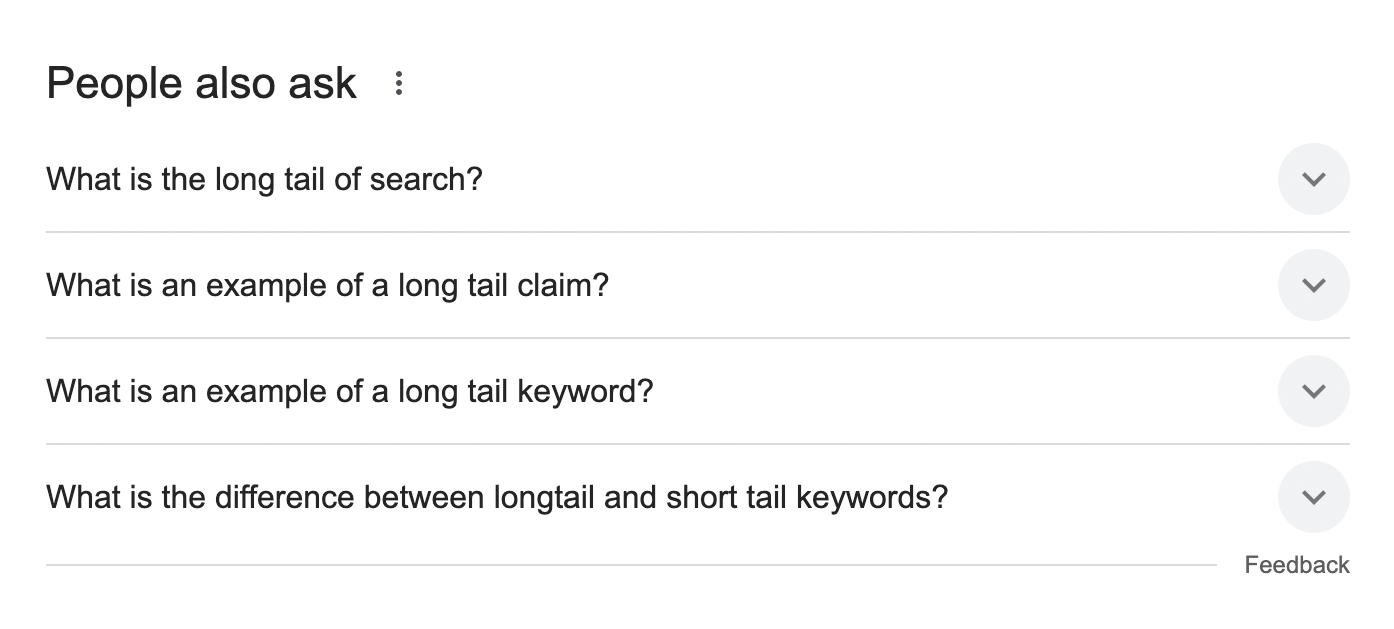
Utilise tools like Google Keyword Planner, Ahrefs, Semrush, or even Google’s “People also ask” and “Related Searches” features, alongside analysing your own Google Search Console data, to uncover the specific, conversational questions your audience is asking.
Great, Well Structured Content
Create comprehensive “pillar” content around broad topics, and then build “cluster content” (individual blog posts, guides, FAQs) that delves into specific long-tail aspects of that pillar. This internal linking structure signals expertise to both traditional search engines and AI.
Patience and Consistency
Ranking for individual long-tail terms might not bring a flood of traffic overnight, but the cumulative effect of hundreds or thousands of these terms over time can be monumental. It’s a continuous process of identifying, creating and optimising.
Long Tail Yadda Yadda … So What?
Search is changing, the update of AI is rapid but some things haven’t changed. Indeed, with LLMs processing content ever faster, the need for real, export content has never been greater.
Search is still massive but AI is stealing a march and it will make your website less visible. Only by sharing your real expertise in a structured, detailed manner can you begin to gain traffic.
- SEO once consisted of structuring your content around keywords.
- It still does.
- … but now the key terms are long. Accommodating them into your content will inevitably result in longer content.
A good content strategy will not be built overnight and, like all SEO, the results will not be instant. You need help. You need experts. You need Little Fire Digital.